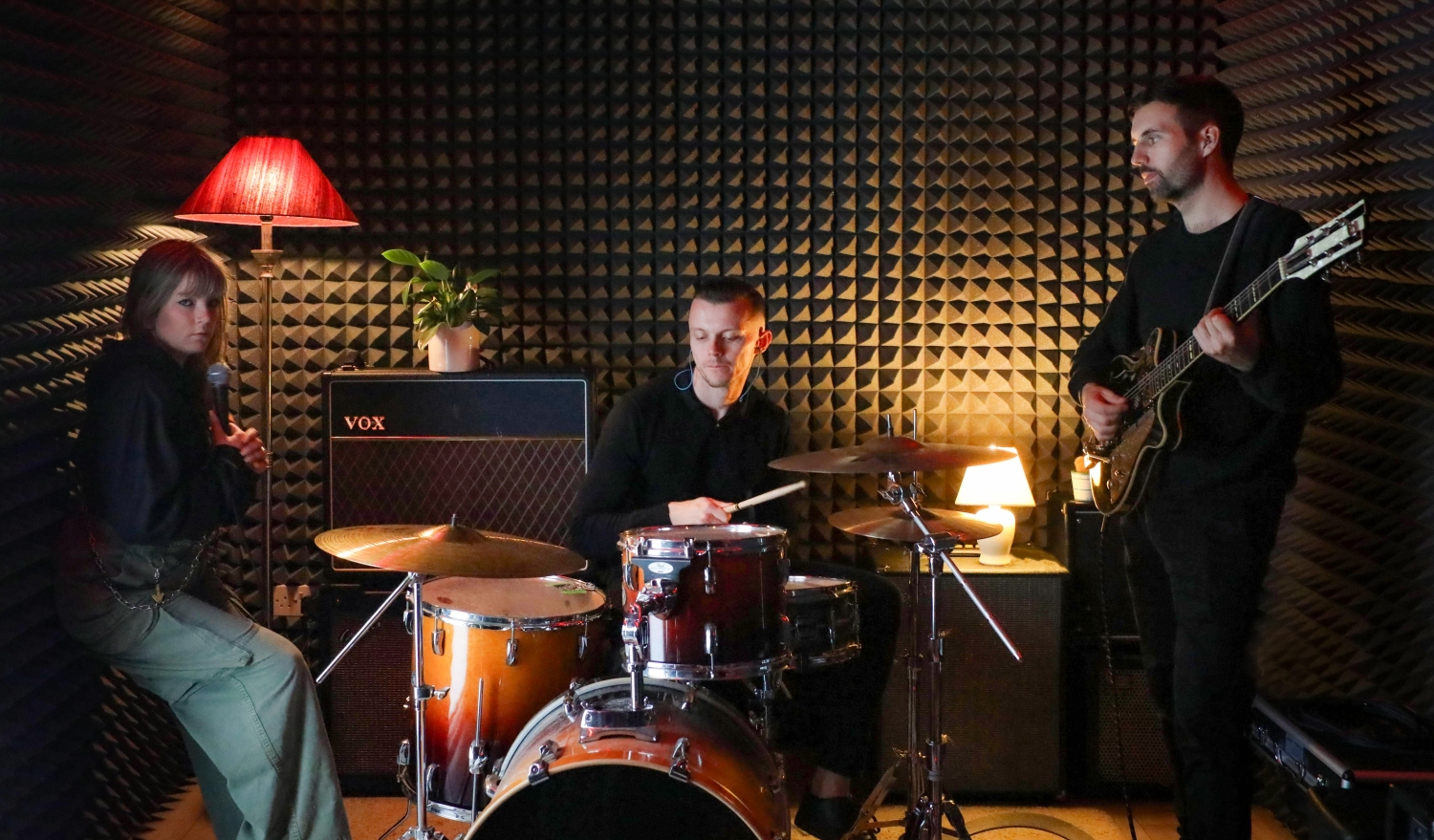
Rising North Dublin trio Curfew step into a defining new chapter with their debut album Black Doll’s Eyes. A record that balances raw alternative hard-rock intensity with cinematic scale, the LP finds the band sharpening their emotional instincts while expanding their sonic world.
Made up of Jj Smilez, Gavin Dunne and Mick Caffrey, Curfew have quietly become one of Ireland’s most compelling new rock acts. Their reputation has been built not only through a string of well-received releases, but through an immersive and electric live presence that’s seen them pack out rooms across Dublin and beyond. Black Doll’s Eyes feels like the natural culmination of that momentum, a debut that leans fully into the band’s dynamic identity.
Recorded, mixed and mastered by Shaun Cadogan at Temple Lane Studios, the album captures Curfew at their most expansive. There’s a precision to the production that allows space for both weight and vulnerability, amplifying the band’s signature cinematic edge without sanding down its grit. Across the record, Curfew traverse intense emotional landscapes and personal reckonings, moving between moments of confrontation and quiet introspection.
One of the album’s standout moments arrives in “Flaketown”, a track that sits in the negative space of modern connection. Musically, it nods backwards with its retro-tinged and warmly textured layers, while its lyrical focus is firmly rooted in the present. The song dissects the strange dissonance of being constantly connected yet emotionally distant, tracing the quiet erosion of intimacy in a screen-dominated world.
Lines like “Swipe it down, then forget I ever saw it / though I love you, I forget to tell you” cut sharply, articulating the gap between intention and habit. The refrain, “Can’t let go, won’t let go, won’t let it die in my hands”, lingers with an uneasy familiarity, crystallising the addictive pull of technology and the way it reshapes our priorities.
Within the wider arc of Black Doll’s Eyes, “Flaketown” acts as both counterpoint and mirror. Where other tracks confront emotion head-on, this song explores absence: detachment, drift, and the subtle violence of disengagement. “Flaketown” becomes a mental and emotional retreat, a place where avoidance is easier than presence, reinforcing the album’s broader examination of self, habit, and the fragile hierarchy of relationships.